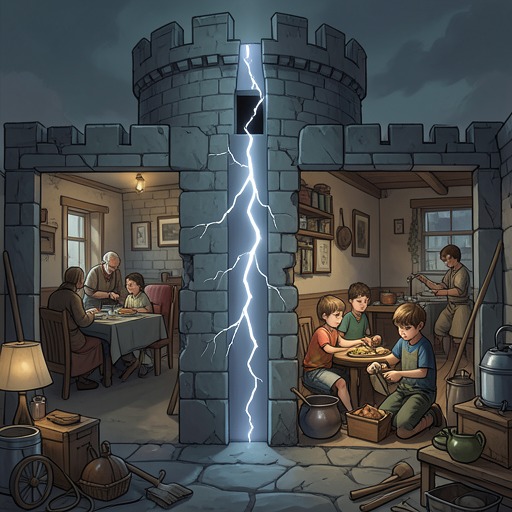
Matt and Borka face off at Hell’s Gap
Ronja, the Robber's DaughterMatt and Borka face off at Hell’s Gap when Borka’s band has occupied the northern part of Matt’s Fort. Their confrontation transforms a dispute over shelter into a direct reckoning between rival robber chiefs: each claims a history of hostility, yet both understand that a battle across the chasm could destroy the people on either side. The encounter ends in a tense withdrawal rather than a victory, leaving the fort contested and the conflict unresolved.
Causes and Setting
The confrontation begins with Borka’s arrival at Hell’s Gap, where he waits for Matt and demands an immediate conversation. Matt is at breakfast, eating his porridge so slowly that he sometimes forgets to open his mouth. The news that Borka is waiting brings the meal to an abrupt end: Matt hurls the wooden platter against the wall, scattering porridge, and ignores Lovis’s reminder that he will have to clean up after himself.
Matt’s robbers climb the stone steps to the fort roof with their mouths still full of porridge. Noddle-Pete remains behind, resentful that his legs will not carry him to the action. Outside, the cold, clear morning casts the first red light of sunrise over the forests around Matt’s Fort. Ronia looks across the gap toward the woods she would rather be exploring, while the two robber bands stand arrayed opposite each other, glaring across the chasm.
Borka explains that his family and band could no longer remain in Borka’s Wood because soldiers were swarming there. He says he had to find somewhere for his wife, child, and robbers. Matt rejects the occupation as a seizure of someone else’s home without permission. Borka turns the accusation back on him: a robber who has always taken what he wanted, he points out, has little standing to condemn another man for doing the same. Matt has no answer, though Ronia does not yet understand what he has taken without asking.
The Confrontation
Matt’s first practical question is how Borka’s band entered the fort: if Matt knows the way in, he says, his men can throw them out the same way. Borka refuses to be drawn into talk of expulsion and explains that a climber reached the steep walls with a long, strong rope trailing behind him. He pats Birk’s red topknot as he describes this resourceful means of entry. Birk smiles, while Ronia watches him from across the divide and resents his knowing, friendly manner.
The argument reaches beyond possession of the fort to the clans’ history. Matt invokes his father’s hostility toward the Borka family; Borka says that this bullying taught him to regard every member of Matt’s clan as an enemy, living or dead. Before that, Borka says, neither man had fully understood that the two families belonged to opposing clans. Matt now declares that the division is plain to him: either a Borka robber will be mourned as dead, or Borka and his band will leave the fort by the way they entered.
Borka does not accept either outcome. He answers that there may indeed be lamentation, but that he has made a home in Borka’s Keep and intends to stay. The exchange makes the dispute more than a tactical question about an entrance: for Borka, the occupied stronghold has become a home for a displaced family, while Matt regards the presence of a rival band inside his fort as intolerable.
Armed Restraint and Immediate Aftermath
Matt ends the meeting by insisting that time will show how matters turn out. His robbers growl and want to draw their bows at once; Borka’s men are armed as well. Yet both chiefs recognize that a fight at Hell’s Gap can end badly for everyone. They part after exchanging one last round of insults, as though abuse were the required closing ritual of a meeting that neither man can resolve by force without risking a mutual disaster.
The return to the stone hall does not look like a conqueror’s procession. Matt and his robbers come back subdued, and Noddle-Pete silently surveys them before smiling his sly, toothless smile. He compares Matt’s failed attempt to confront Borka to a wild bull crashing about the fort. His mockery gives the retreat a comic edge, but it also underlines the practical outcome: Matt has not driven Borka out, and the challenge he issued has produced no settlement.
The Dispute’s Moral Reach
The clash’s accusation about taking what belongs to others becomes newly significant when Ronia learns what her father’s robbers do. She asks whether the people whose possessions are taken become terribly angry; Noddle-Pete confirms that they do, and even takes pleasure in their outrage. Matt then presents his family history as a justification: his father, grandfather, and great-grandfather were robber chiefs, and he says he has upheld their tradition by becoming the mightiest chief in the woods and mountains. He expects Ronia to follow him.
Ronia refuses. She cries that she will never become a robber chief, even if the victims get angry and cry. Matt wants her admiration and love, and her refusal troubles him; he tries to persuade her that taking only from the rich makes his conduct right. The contradiction already sharpened at Hell’s Gap—Matt condemning Borka for taking a home while Borka reminds him that he, too, takes without asking—therefore reaches into the father-daughter relationship. In Ronia’s judgment, the decisive question is not which clan claims the stronger inheritance, but what happens to the people robbed.
That judgment returns when Matt captures Birk and calls him a little thieving hound while claiming he is clearing his father’s fortress. Ronia tells Matt that he may rob money, goods, and rubbish, but that if he robs people she no longer wants to be his daughter. The conflict at Hell’s Gap thus foreshadows a deeper division than the one in the stone walls: the old feud sets the clans against each other, while Ronia’s rejection challenges the robber life shared by both sides. Later, when Noddle-Pete proposes that a single combat might make Borka reasonable and unite the bands, Ronia answers that the cleverest idea would be to stop robbing. The standoff’s unresolved question—how the bands can live together—ultimately meets a more radical answer in her refusal of the practice itself.